
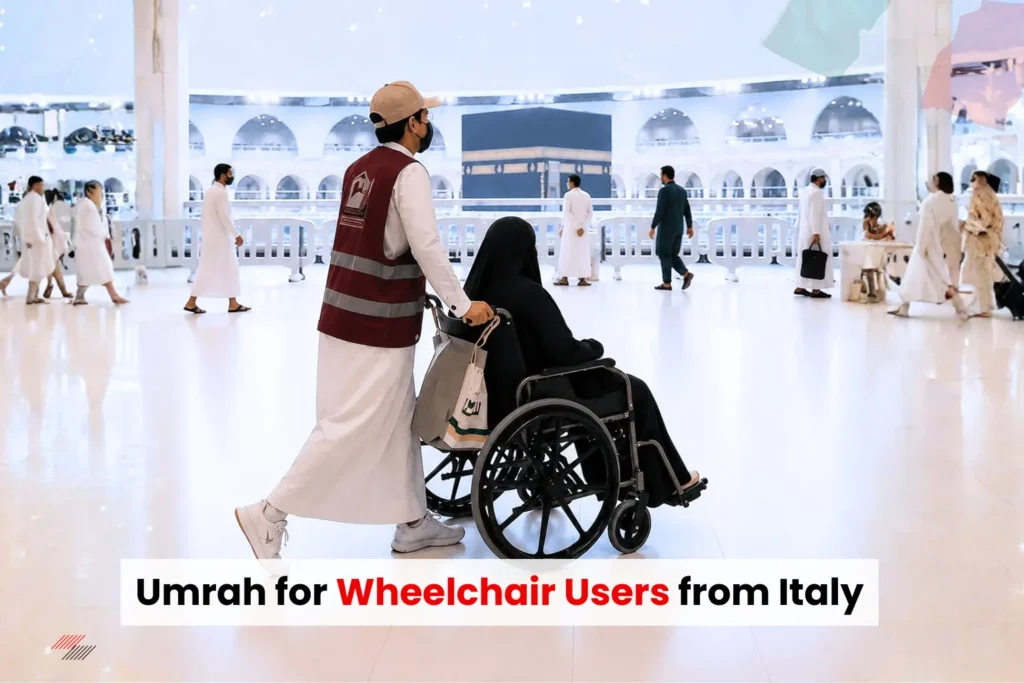
Planning Umrah from Italy with a wheelchair user, an elderly parent, or a family member with limited mobility requires a little more preparation than an ordinary trip.
The good news is that wheelchair users can plan an Umrah journey, and both Masjid al-Haram in Makkah and Masjid an-Nabawi in Madinah have accessibility services and facilities for elderly pilgrims and people with disabilities.
But accessibility is not only about what happens inside the mosque.
For a family travelling from Italy, the journey starts at the airport and continues through the flight, arrival in Saudi Arabia, airport transfers, hotel, movement around Makkah and Madinah, and finally the journey home.
This guide explains the practical points to consider when planning Umrah for wheelchair users from Italy, including airport assistance, accommodation, transport, Tawaf, Sa’i and travelling with elderly family members.
Can Wheelchair Users Perform Umrah?
Yes, wheelchair users can plan and perform Umrah, but the journey should be planned around their individual mobility needs.
Saudi authorities provide mobility services and accessibility facilities at the holy mosques. At Masjid al-Haram, services include wheelchair and electric-cart options as well as infrastructure designed to help elderly visitors and people with disabilities.
At Masjid an-Nabawi in Madinah, official information from 2026 describes manual and electric wheelchairs, carts, accessible entrances, ramps, elevators and dedicated routes for older people and people with disabilities.
However, having accessible facilities available does not mean that every part of an Umrah journey will automatically be easy.
A family should consider:
- How will the wheelchair user travel through the Italian airport?
- Is airport assistance booked in advance?
- Will there be a connecting flight?
- How will the wheelchair be handled?
- Is the Saudi transfer vehicle suitable?
- Is the hotel genuinely accessible?
- How far is the hotel entrance from the practical route to the Haram?
- Where can the wheelchair user rest?
- What assistance is available at the holy mosque?
- How much walking will the accompanying family members need to do?
Planning these details before departure can make the journey considerably easier.
Travelling to Umrah from Italy with a Wheelchair
The first stage of an accessible Umrah journey is the journey from your home in Italy to the airport.
Don’t leave accessibility arrangements until the day of departure.
When booking your flight or Umrah package, clearly explain the passenger’s mobility requirements to the airline, travel agency or tour operator.
In Italy, passengers with disabilities or reduced mobility (PRMs) are entitled to airport assistance under the applicable European rules. ENAC states that assistance can cover movement through the airport, check-in, security and passport procedures, boarding and disembarkation, baggage collection and connections.
Request airport assistance in advance
ENAC recommends requesting assistance when booking the flight. The request should be made at least 48 hours before departure to allow the service to be organised properly.
This is particularly important for an Umrah journey because the trip may involve:
- a long flight
- a connecting airport
- multiple terminals
- immigration procedures
- a large amount of luggage
- a wheelchair or other mobility equipment
If you are booking through a travel agency or tour operator, make sure the mobility requirement is clearly communicated and confirmed.
What can airport assistance include?
Depending on the passenger’s needs, airport assistance can include help:
- from a designated meeting point to check-in
- through security and passport control
- to the aircraft
- with boarding
- from the aircraft door to the seat
- when disembarking
- to baggage collection
- between connecting flights
- to a designated point after baggage collection
ENAC also provides for ground handling of mobility equipment when the required advance notice has been given.
Can I Take My Own Wheelchair from Italy to Saudi Arabia?
In many cases, mobility equipment can be carried as part of the passenger’s journey, but the exact conditions can depend on the airline and the type of wheelchair.
ENAC states that airlines must provide for the carriage of up to two pieces of mobility equipment for a passenger with reduced mobility, including electric wheelchairs, subject to advance notice, available space and applicable dangerous-goods requirements.
If the wheelchair is electric or battery-powered, do not assume that the airline’s requirements are the same as for a manual wheelchair.
Before travelling, confirm with the airline:
- wheelchair dimensions
- weight
- battery type
- whether the battery is removable
- how the wheelchair must be prepared
- where it will be handed over
- where it will be returned
- whether special documentation is required
If you are booking an Umrah package, provide these details to your travel company before the booking is finalised.
Understanding PRM Assistance When Flying from Italy
You may hear terms such as PRM or wheelchair assistance when booking flights.
PRM means Passenger with Reduced Mobility.
The exact assistance provided depends on the passenger’s needs. Therefore, don’t simply say “wheelchair assistance” if the person has difficulty walking, standing or transferring.
Explain what the passenger can and cannot do.
For example:
- Can they walk short distances?
- Can they climb aircraft stairs?
- Can they stand for a short period?
- Can they transfer from a wheelchair to an aircraft seat?
- Do they need assistance throughout the airport?
- Are they travelling with their own wheelchair?
Providing accurate information helps the airline and airport arrange the appropriate assistance.
Is Masjid al-Haram Accessible for Wheelchair Users?
Masjid al-Haram has extensive accessibility facilities for elderly pilgrims and people with disabilities.
Saudi authorities have reported accessible routes and mobility services designed to help visitors move around the mosque and surrounding areas. Services include wheelchairs and electric transportation options, including services associated with Tawaf and Sa’i.
Official Saudi reporting in 2026 also highlighted dedicated mobility services for elderly visitors and people with disabilities, including electric transportation and organised routes designed to reduce physical effort during busy periods.
This means wheelchair users should not assume that they have to manage the entire Haram journey independently.
However, conditions can vary depending on:
- time of day
- crowd levels
- current operational arrangements
- entrance being used
- type of mobility assistance required
- temporary arrangements
For that reason, it is sensible to check the current arrangements after arriving in Saudi Arabia and follow instructions from the mosque’s staff.
Can a Wheelchair User Perform Tawaf?
Wheelchair users can plan their Tawaf with the available mobility services at Masjid al-Haram.
Saudi authorities have specifically reported mobility services and electric carts associated with facilitating movement for pilgrims, including elderly visitors and people with disabilities.
The practical experience may depend on the type of wheelchair, the level of assistance required and the current crowd conditions.
Before Tawaf, consider:
- How will the wheelchair user reach the appropriate area?
- Will you use the person’s own wheelchair or an available service?
- Does the accompanying person need to remain with them?
- What route is currently recommended?
- Are there current restrictions or operational changes?
- Is the person comfortable with the expected duration and crowd?
A note about religious guidance
The practical accessibility arrangements are different from the religious rules concerning Tawaf.
This article focuses on travel and accessibility rather than issuing a religious ruling. If you have a specific question about the validity or method of performing Tawaf while seated or assisted, ask a qualified Islamic scholar before travelling.
Can a Wheelchair User Perform Sa’i?
Sa’i between Safa and Marwah is another important part of the accessibility plan.
The Saudi authorities provide mobility services for pilgrims who need assistance, and official reporting has highlighted wheelchair and electric mobility options for people using the Haram facilities.
For a wheelchair user, the important practical considerations are:
- identifying the appropriate accessible route
- understanding where mobility services are available
- allowing sufficient time
- avoiding unnecessary physical strain
- staying with the accompanying family member
- following current instructions from mosque staff
Again, the religious requirements of Sa’i should be confirmed with a qualified scholar if the pilgrim has a specific religious question about performing it with mobility assistance.
Wheelchair Accessibility in Madinah
Accessibility planning should continue after leaving Makkah.
Masjid an-Nabawi in Madinah also provides facilities intended to support elderly visitors and people with disabilities.
Official Saudi information published in 2026 describes:
- manual wheelchairs
- electric wheelchairs and carts
- accessible pathways
- accessible entrances
- ramps
- elevators
- designated routes
- suitable prayer areas
- guidance services
- specially equipped facilities
The authorities also reported field teams assisting elderly visitors and people with disabilities in reaching prayer areas and other facilities.
For families travelling from Italy, this means Madinah should be included in the accessibility plan from the beginning rather than treated as an ordinary sightseeing stop after Makkah.
Choosing a Wheelchair-Accessible Hotel in Makkah
This is one of the most important decisions for a wheelchair user.
A hotel can advertise itself as “close to Haram” without necessarily being convenient for someone who cannot walk comfortably.
Before booking, ask specific questions.
Hotel accessibility checklist
Ask the hotel or travel agency:
- Is the main entrance step-free?
- Is there an accessible entrance?
- Are the elevators suitable for the wheelchair?
- Is the bedroom large enough for wheelchair movement?
- Is the bathroom accessible?
- Does the bathroom have suitable grab rails?
- Is the shower accessible?
- How wide are the doors?
- Is there enough space around the bed?
- Where does the hotel vehicle drop passengers?
- How far is the drop-off point from the entrance?
- Are there steps or steep slopes?
- Is a hotel shuttle available?
- Does the shuttle accommodate wheelchairs?
Do not rely only on a hotel’s star rating.
For a wheelchair user, location + entrance + elevator + room + bathroom + transport may matter more than an extra hotel star.
How Close Should Your Hotel Be to the Haram?
For a young and physically fit traveller, a hotel described as “10 minutes from Haram” might be acceptable.
For an elderly person or wheelchair user, that description isn’t enough.
The real question is:
How easy is the entire route between the hotel and the practical entrance or access point?
A short distance on a map may still involve:
- crowds
- slopes
- road crossings
- long walking routes
- waiting for elevators
- difficult vehicle access
- crowded entrances
This is why families travelling with elderly or wheelchair users should discuss the actual accessibility of the accommodation and transfer route before booking.
Accessible Transport During Umrah
Transport is another part of the journey that is easy to overlook.
A wheelchair user may be comfortable inside the mosque but struggle if the vehicle used between the airport, hotel and other destinations cannot accommodate the wheelchair conveniently.
Before travelling, ask:
- Can the wheelchair fit in the vehicle?
- Does the passenger need to transfer to a normal car seat?
- Is there sufficient luggage space?
- Is assistance available when getting into the vehicle?
- Where will the vehicle drop passengers?
- Can the vehicle approach the hotel entrance?
- What happens if the wheelchair is large or electric?
The answers can vary depending on the vehicle and mobility equipment, so confirm the arrangements for your specific trip rather than assuming every transfer vehicle is accessible.
Travelling to Umrah with an Elderly Parent
Not every elderly pilgrim uses a wheelchair.
Some can walk but become tired quickly. Others may need assistance only for longer distances.
If you are travelling with an elderly parent, think beyond the question:
“Can they walk?”
Ask:
“How much walking can they comfortably manage in a busy environment?”
An elderly pilgrim may have no difficulty walking around the house but struggle with:
- long airport corridors
- standing in queues
- crowded areas
- repeated walking between hotel and mosque
- hot weather
- long transfers
- waiting for elevators
- several activities in one day
A sensible itinerary should therefore include enough time for rest.
You don’t need to make every day busy simply because you are in Makkah or Madinah.
Travelling with a Disabled Family Member
When a family member has a disability or limited mobility, one person should ideally take responsibility for coordinating the practical details.
Before leaving Italy, create a simple travel plan containing:
- flight details
- airport assistance confirmation
- wheelchair information
- hotel details
- transfer information
- emergency contacts
- medication information
- travel documents
- family contact numbers
Keep important information available both digitally and offline.
If several family members are travelling together, make sure everyone knows who will accompany the wheelchair user during airport transfers and between the hotel and mosque.
What Should You Arrange Before Leaving Italy?
Use this checklist before departure.
Documents and travel
- Passport and required travel documents
- Flight confirmation
- Umrah/travel arrangements
- Hotel confirmation
- Saudi transfer details
- Emergency contact information
Mobility
- Tell the airline about reduced mobility
- Request airport assistance
- Confirm assistance at transit airports
- Confirm wheelchair arrangements
- Check electric wheelchair/battery requirements
- Confirm how and where the wheelchair will be handed over
Accommodation
- Confirm accessible room requirements
- Confirm elevator access
- Ask about bathroom accessibility
- Confirm vehicle drop-off arrangements
- Check the practical distance to the Haram
Personal preparation
☐ Medication
☐ Essential mobility equipment
☐ Comfortable clothing
☐ Suitable footwear
☐ Water bottle where appropriate
☐ Phone and chargers
☐ Copies of important documents
Questions to Ask Your Umrah Travel Agency
If you are booking an Umrah package from Italy for a wheelchair user or elderly parent, don’t simply ask:
“What is the price?”
Ask these questions as well:
- Is the hotel suitable for a wheelchair user?
- How far is the hotel entrance from the practical Haram access route?
- Is the room accessible?
- Is the bathroom accessible?
- Can the transfer vehicle accommodate the wheelchair?
- Can airport assistance be arranged?
- Are there connecting flights?
- Who should I contact if assistance is needed during the journey?
- What happens if the wheelchair is delayed or damaged?
- Can you help us plan the trip around the mobility needs of our family member?
A good accessibility conversation should happen before the package is finalised, not after the family arrives in Saudi Arabia.
A Practical Wheelchair Umrah Checklist
| Before leaving Italy | During the Umrah journey |
|---|---|
| Request airport assistance | Confirm hotel accessibility |
| Confirm wheelchair arrangements | Check the easiest route to the Haram |
| Check airline requirements | Ask about current mobility services |
| Confirm accessible accommodation | Allow time for rest |
| Confirm transfer arrangements | Avoid unnecessary walking |
| Prepare medication | Follow current mosque guidance |
| Save emergency contacts | Keep family members together |
| Carry important documents | Reconfirm arrangements when necessary |
Is Umrah Difficult for Wheelchair Users?
The answer depends heavily on the individual’s mobility needs and how well the trip is planned.
The existence of accessibility facilities does not remove every challenge.
Large crowds, long journeys, waiting times, weather, hotel distances and airport procedures can all affect the experience.
That is why the most useful approach is not simply asking:
“Is Umrah wheelchair accessible?”
Instead, ask:
“Is our entire Umrah journey planned around this person’s specific mobility needs?”
That change in thinking can make the planning process much more practical.
Tips for a More Comfortable Umrah Journey
1. Plan accessibility from the beginning
Don’t book flights and hotels first and think about mobility later.
2. Tell your travel provider exactly what is needed
“Wheelchair user” can mean different things. Explain the person’s actual abilities and limitations.
3. Request airport assistance early
ENAC recommends requesting PRM assistance at booking and at least 48 hours before departure.
4. Confirm everything in writing
Keep confirmations for flights, hotel, transfers and accessibility arrangements.
5. Choose accommodation carefully
The cheapest or closest-looking hotel isn’t necessarily the easiest option for an elderly or wheelchair traveller.
6. Leave room for rest
Don’t build an itinerary where every day is packed.
7. Check current arrangements after arrival
Accessibility services and operational routes can change. Follow current instructions from the relevant authorities and mosque staff.
8. Don’t be afraid to ask for help
Saudi authorities have dedicated services for elderly pilgrims and people with disabilities at the holy mosques.
Frequently Asked Questions
Can wheelchair users perform Umrah?
Yes. Wheelchair users can plan an Umrah journey, and accessibility and mobility services are available at the holy mosques. Individual needs should be considered when arranging flights, accommodation, transport and movement during the pilgrimage.
Is Masjid al-Haram wheelchair accessible?
Yes. Saudi authorities provide accessibility infrastructure and mobility services at Masjid al-Haram, including wheelchair and electric mobility options. Current arrangements can vary according to operational conditions and crowd management.
Can wheelchair users perform Tawaf?
Wheelchair users can use available mobility arrangements at Masjid al-Haram. For questions about the religious rules governing Tawaf while using a wheelchair, consult a qualified Islamic scholar.
Can wheelchair users perform Sa’i?
Mobility services are available for pilgrims who need assistance, including wheelchair and electric mobility options. Current routes and arrangements should be confirmed at the mosque.
Is Masjid an-Nabawi wheelchair accessible?
Yes. Official Saudi information describes manual and electric wheelchairs, carts, ramps, accessible entrances, elevators and dedicated routes for elderly visitors and people with disabilities.
Can I take my wheelchair from Italy to Saudi Arabia?
Mobility equipment can be carried subject to the applicable airline requirements. ENAC states that airlines provide for the carriage of up to two pieces of mobility equipment, including electric wheelchairs, subject to advance notice, space and applicable safety requirements. Always confirm the current conditions directly with your airline.
How do I request wheelchair assistance at an Italian airport?
Request it through the airline, travel agency or tour operator when booking. ENAC recommends making the request at least 48 hours before departure.
Is airport wheelchair assistance free in Italy?
Under the applicable PRM rules, airport assistance for passengers with reduced mobility is provided free of charge. The assistance can cover various stages of the airport journey, including check-in, security, boarding, disembarkation and baggage collection.
Can I travel to Umrah with an elderly parent?
Yes, but the trip should be planned around your parent’s mobility, stamina and individual needs. Hotel location, transport, airport assistance and rest periods can be particularly important.
What should I ask a hotel before booking?
Ask about step-free access, elevators, room dimensions, bathroom accessibility, entrance access, vehicle drop-off and the practical route to the Haram.
Should I book a hotel close to Haram if travelling with a wheelchair user?
Being close can be helpful, but distance alone does not determine accessibility. Ask about the actual route from the hotel entrance and vehicle drop-off point to the areas you need to access.
Should I arrange wheelchair assistance before leaving Italy?
Yes. Early planning is strongly recommended. ENAC specifically advises passengers with reduced mobility to request assistance when booking and at least 48 hours before departure.
Planning Umrah for Wheelchair Users?
An accessible Umrah journey is not simply about finding a wheelchair.
It is about connecting all the parts of the trip:
Home → Italian airport → flight → Saudi arrival → transfer → hotel → Haram → Tawaf → Sa’i → Madinah → return journey.
If one part of that chain is overlooked, it can create unnecessary difficulty for the pilgrim and the family travelling with them.
For this reason, families travelling from Italy should discuss their mobility requirements before booking their Umrah arrangements.
At Vipiteno Travels, accessibility requirements can be discussed as part of your Umrah planning, including accommodation, transportation and the practical needs of elderly or mobility-limited family members.
If you are planning Umrah from Italy with a wheelchair user or elderly parent, contact Vipiteno Travels before booking so that the journey can be planned around your family’s specific needs.
Important Note
Accessibility facilities, airline procedures, transport arrangements and Saudi travel requirements can change. Information about current services should always be reconfirmed with the relevant airline, airport, Saudi authorities or service provider before departure.
This guide focuses on travel and accessibility planning. It does not replace medical advice or a qualified Islamic scholar’s guidance on religious questions relating to the performance of Umrah.